Perth Airport and its air traffic control tower have had many transformations over the past 80 years.
The simple wooden, single-storey tower has long been replaced, most recently by an 80 metre tower opened by then Prime Minister Bob Hawke in 1987.
The Perth Airport (which was previously known as Guildford Aerodrome in the late 1930s) and the Civil Aviation Historical Society (CAHS) have shared with us historical images featuring the many faces of Perth Tower.
As with any story, a timeline is an important source of understanding history. The chronology of significant dates showcases how technology and infrastructure have changed over the years.
Together with ATM Service Manager Bruce Dowdall, air traffic controller Phil Vabre and former air traffic controller Geoffrey Goodall, the following detailed timeline was pieced together:
- 1942-1944: A simple timber-framed single-storey ‘control tower’ was built.
- 1946: The first control tower was built using steel girders and located approximately where the Qantas Domestic Terminal is now.
- 1952: Military buildings were adapted to civilian needs—Qantas opens air service from Sydney to Johannesburg via Perth, Cocos and Mauritius.
- 1962: A control tower and fire station was built as Perth Airport prepared for the 1962 Commonwealth Games. When the Tower first opened, area and approach control (all procedural) was done from the Tower, in addition to aerodrome control.
- 1960s: Runway extensions occurred to accommodate jet aircraft.
- 1969: ‘Adjunct to Procedural Approach’ provided by radar controller at Kalamunda.
- 1970: New Interim Area Approach Control Centre (AACC) style console commissioned in the 1962 tower.
- 1971: Arrivals (procedural) moved from Tower to Area Control Centre (ACC) located next to ATC Ops/Briefing in Terminal Building.
- 1974: Approach control moved from the tower to Kalamunda and provided by radar.
- 1980s: A $40m modernisation and expansion programme took place to accommodate B747s; including a 300m extension of the north-south runway.
- 1981: ACC, Interim AACC, Flight Service Unit (FSU) and Techs moved into newly-built Ops Centre at Perth Airport.
- 1982: Design work on a modern tower began with construction of the tower commencing in 1984 and completing in 1987. The Tower is situated behind the Terminal, relative to the runways.
- 1986: Prime Minister Bob Hawke opened the new international terminal on 25 October.
- 1987: Operations begin in the new tower— Perth Tower commissioned as RADAR Tower.
- 1999: Computerised ATC EUROCAT technology commissioned in Tower.
- 2015 (March): Ground surveillance (A-SMGCS) commissioned at Perth Tower.
- 2016 (October): Integrated Tower Aviation Suite (INTAS) project commissioned.
- 2017 (April): Transmissometer (device used for determining runway visual range in low visibility conditions) commissioned.
- 2018 (March): Historic Perth to London flight takes to the skies.
- 2018 (April): Cat III ILS & Stopbar integration.
- Present day: Operations continue to run in our 1987 tower.
View the historical photos below. Click to enlarge.
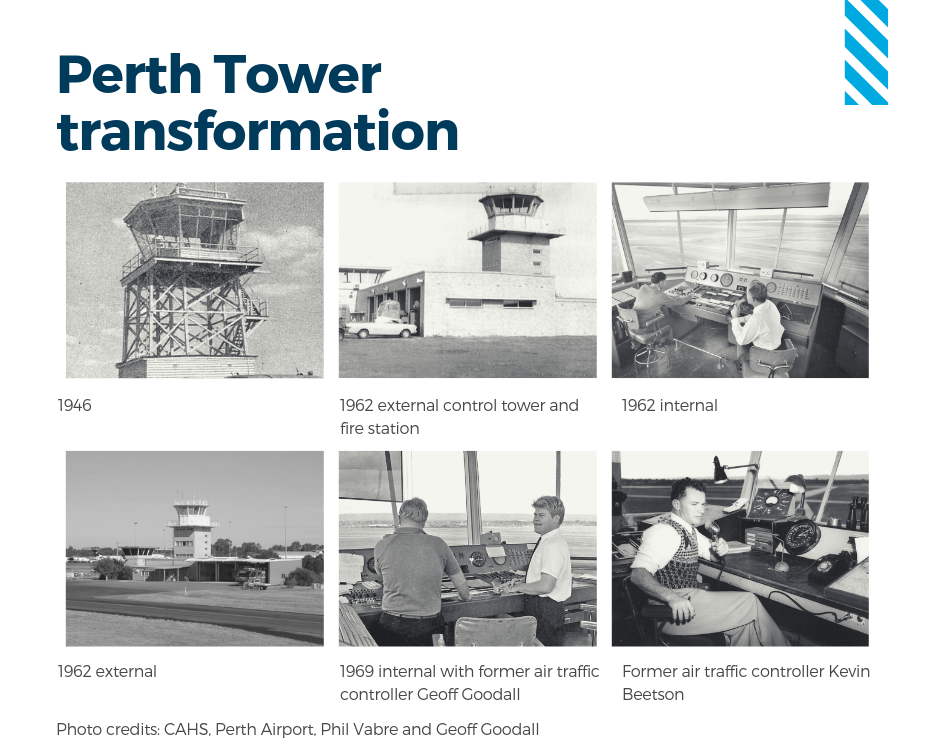
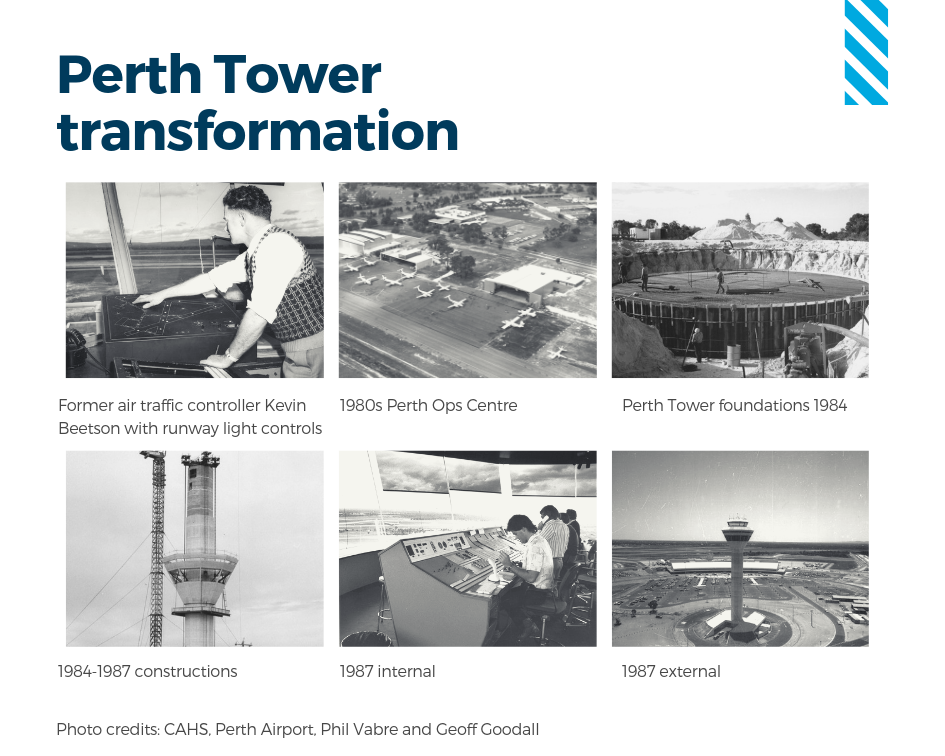
Photo credits: Perth Airport, CAHS, Phil Vabre and Geoff Goodall
References
CAHS. (n.d.). Construction of Perth International Terminal – 1985. Retrieved 2019, from The Civil Aviation Historical Society & Airways Museum: http://www.airwaysmuseum.com/PH%20Int%20Terminal%2085.htm
CAHS. (n.d.). Perth – Second Control Tower & Fire Station. Retrieved 2019, from The Civil Aviation Historical Society & Airways Museum: http://www.airwaysmuseum.com/PH%20TWR%202%201.htm
Chen, L. (2007). National survey of Control Towers 2007.
Eyre, D. (2013). Perth Airport 1962 Control Tower & Fire Station: History. Retrieved from AviationWA: http://www.aviationwa.org.au/articles/airports/perth-airport-1962-control-tower-fire-station-history/