
Driving safe operations
Runway safety
International Civil Aviation Organization (ICAO) and Airservices consider runway safety to be one of their highest priorities as it remains one of the most serious threats to aviation safety. Airservices continues to work with the aviation industry to improve runway safety.
Runway safety issues can include runway incursions, runway excursions and runway confusion. Improving runway safety requires collaboration from all stakeholders, including ATC, Airports, CASA, Aircraft Operators and anyone else who operates around a runway.
Runway incursion
ICAO defines a runway incursion to be “Any occurrence at an aerodrome involving the incorrect presence of an aircraft, vehicle or person on the protected area of a surface designated for the landing and take off of aircraft” (ICAO Doc 4444–PANS-ATM).
Runway incursions are an ongoing safety concern. There are multiple occurrences in Australia and around the world every month that can result in fatal collisions between aircraft, and aircraft and vehicles. Reducing the number of runway incursions is paramount to improving runway safety.
The following documents can support you to prepare for operating at an aerodrome safely and prevent a runway incursion.
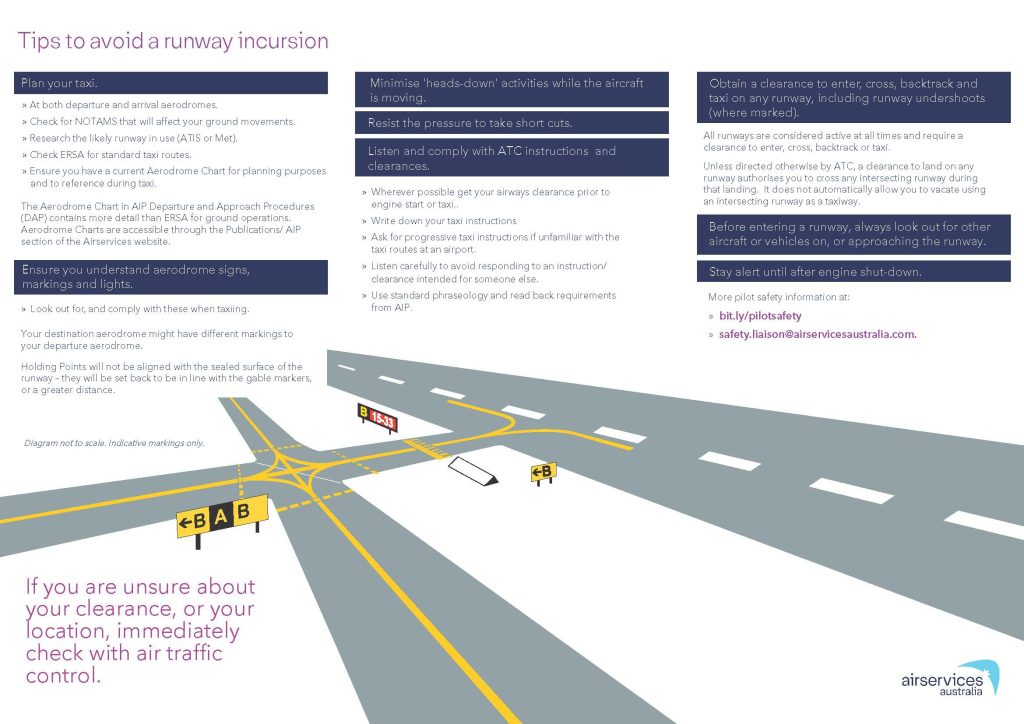
Runway incursion hot spots
Hot spot diagrams are an ICAO endorsed and internationally recognised method of providing information about aerodrome locations that have an increased risk for incursions. The diagrams provide recommendations for ensuring runway safety. Significant hot spots are included in the aerodrome diagrams in ERSA and DAP in the AIP.
Tips for flying at metro D aerodromes
At busier aerodromes, like at Metro Ds, there is less time available for both controllers and pilots to identify hazards and resolve possible conflicts. This is where your knowledge along with your communication with ATC is crucial. You can find specific operational information about the aerodrome your are operating in by visiting the aerodrome facilities section in ERSA.
The following documents can support you to prepare for operating at specific aerodromes and prevent a runway incursion.
Aerodrome manoeuvring maps
For further annotated versions of the runway diagrams found in the AIP, including the aerodromes listed above and the Gold Coast and Sunshine Coast, visit CASA's aerodrome manoeuvring maps.
Runway incursion analysis
Airservices analyses runway incursion data to identify the trends and key contributing factors of runway incursion occurrences.
This kind of analysis helps support our decision-making around safety and informs the industry about current and emerging risks.
Runway incursion analysis presentation.
Pilot responsibility
Runway stop bars
Stop bars are intended to provide additional protection of runway/taxiway intersections to reduce runway incursions by:
- enhancing visibility of holding points
- reinforcing the control of aircraft and vehicles in the vicinity of holding points
- increasing the defence against controller error in aircraft or vehicle identification.
Read more about runway stop bars in the
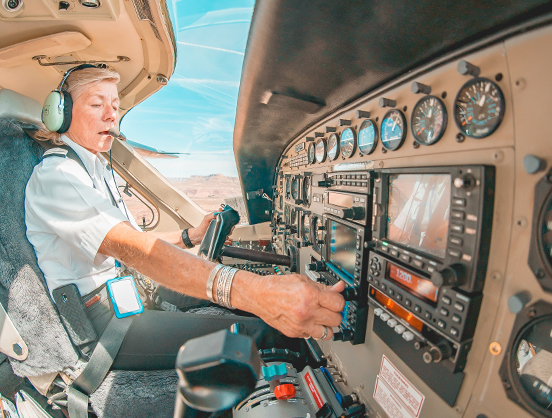
Pilot responsibility
Common Traffic Advisory Frequency (CTAF) procedures
CTAF procedures in Australia are used by pilots when operating in the vicinity of non-towered airports or aerodromes. These procedures are intended to ensure that all pilots in the vicinity are aware of each other's position, intentions, and movements, in order to maintain safe and orderly operations.
For further information, please read the
Pilot responsibility
Pre-flight preparation
Thorough pre-flight preparation is a good way to ensure safe runway operations.
By solving potential problems before you enter the runway, you reduce the likelihood of runway incursions, runway excursions and runway confusion.

Preparing for safer runway operations
Other runway users
Airside drivers
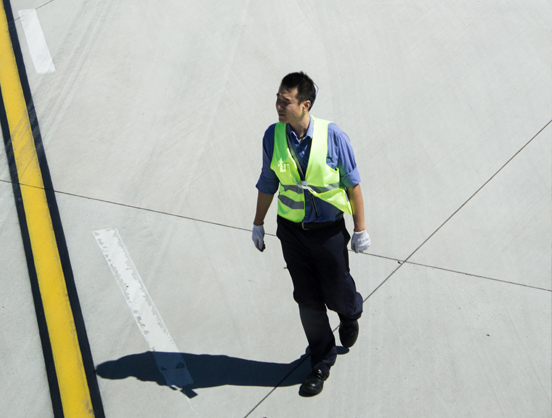
Airside drivers play an essential role in runway safety at all aerodromes. Instances of serious runway incursions have involved airside vehicles; therefore, drivers need to take steps to ensure they are prepared to operate safely around runways.
The airside driver's guide to runway safety provides tips on how to:
-
- avoid an airside incident or runway incursion
- improve airside driver safety
- speak to Air Traffic Control and understand clearances and instructions
- maintain situational awareness.
Local runway safety teams
Local Runway Safety Teams (LRST) are an important component of the global runway safety program. The LRST consists of local representatives addressing local runway safety issues. At some airports the LRST is embedded in another aerodrome meeting, such as the Aerodrome Users Group or Airport Safety Committee.
For more information, view the:
Runway safety checklists
Airservices has developed a Runway Safety Checklist to allow pilots (or aircraft operators), Controllers (or ATC organisations) and aerodrome staff (or airports) to assess their level of runway safety;
Airservices has worked with CANSO and other stakeholders to develop a Runway Safety Maturity Checklist which allows users to benchmark their levels of maturity with regard to managing runway safety risks.
- CANSO runway safety maturity checklist (PDF) - login is required
In addition to the downloadable version you can complete the Runway Safety Maturity Checklist online by emailing a request for access to rwysafety@eurocontrol.int
Videos and podcasts
A tightening vice | Flight Safety Australia
Hind Sight 12 - Runway excursion | Eurocontrol
Runway confusion | Flight Safety Australia
Seeing red: putting a stop to runway incursions | Flight Safety Australia
Related links
Pilot Safety Hub | CASA
Aviation weather services | The Bureau of Meteorology
Latest investigations & reports | ATSB
Runway incursion | SKYbrary
Runway safety kit | ICAO
Stay ontrack series | CASA
Further reading
Safety publications
Including Safety Bulletins which provide important advice on emerging safety issues.
