
FAQS
Air Traffic Controller training
The job of an air traffic controller has so many aspects that it tends to lead to as many questions. We have collected the most common ones here. The answers are brief so you can quickly find what you need to know.
Due to the large volume of applications we receive, we’re unable to respond via phone to individual enquiries in the early stages of the application process. Our primary method of correspondence in the early stages is via email once you have submitted your application. Please ensure you check your Junk and Spam folders to ensure you receive our correspondence.
We look forward to receiving your application, best of luck!
Organisation and career information
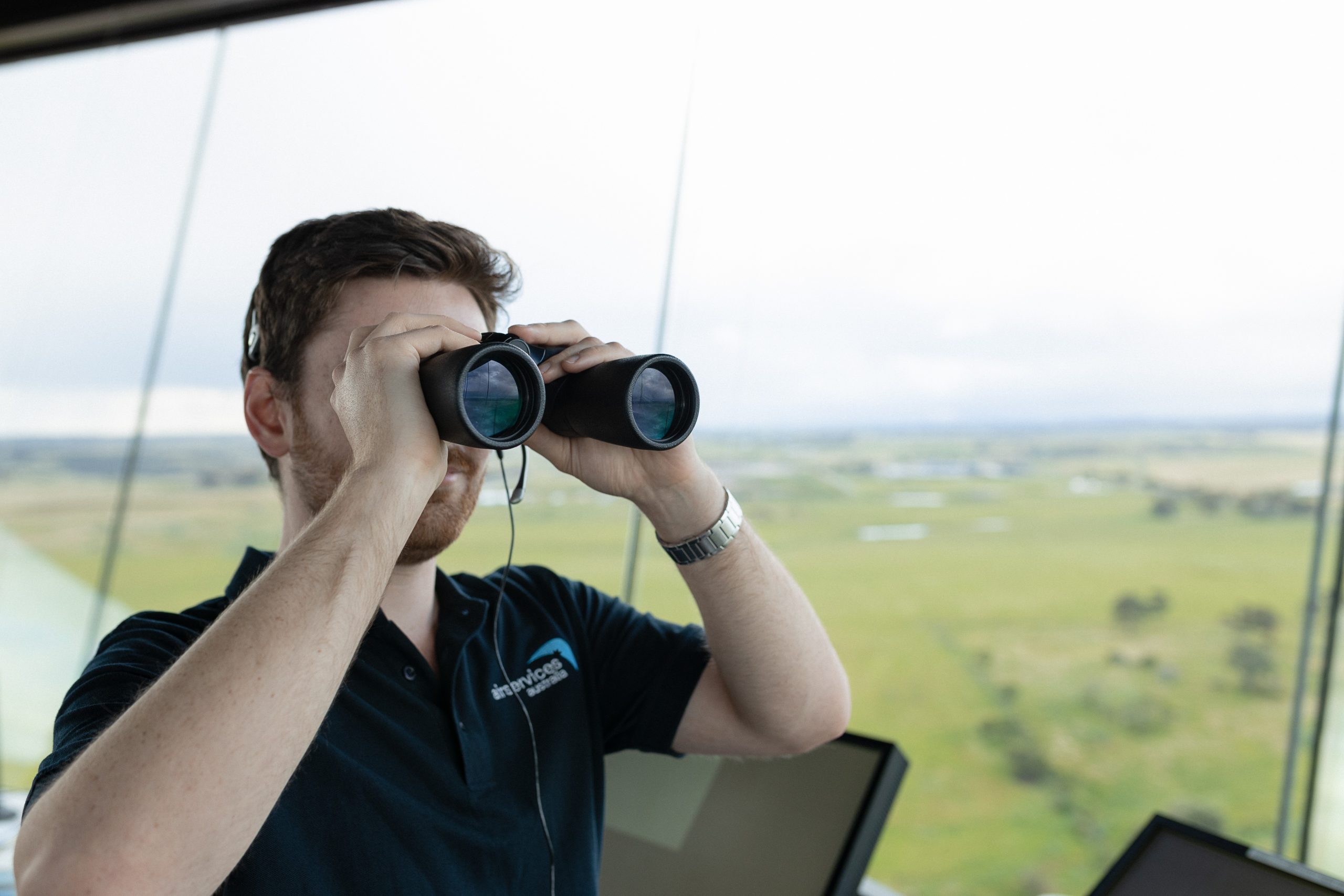
Air Traffic Controllers effectively manage the arrival and departure of more than 156 million passengers annually and are at the centre of our growing aviation industry.
They are at the centre of a dynamic, innovative, digital industry that keeps 11% of the world’s airspace safe.
Air Traffic Controllers track the progress of aircraft using the latest technology. Although aircraft fly to pre-determined schedules, they don’t fly exactly the same way each time, so Air Traffic Controllers must quickly adapt to changing flight plans and unexpected and emergency situations. This is a rewarding role that requires that requires a high level of commitment and responsibility.
Our air traffic controllers are based around the country and work in one of our two major centres in Melbourne or Brisbane, two terminal control units or 28 air traffic control towers at international and regional airports across Australia.
As an air traffic controller you will also find yourself connecting with talented people and great opportunities. You’ll enjoy ongoing training, excellent career development, competitive remuneration and work that’s truly meaningful.
There are three types or streams of Air Traffic Control: Enroute, Tower and Approach.
Enroute controllers manage aircraft between airports from two centres based in Brisbane and Melbourne.
Tower controllers manage aircraft arriving and departing from airports. We have 28 control towers located around Australia, and on completion of your training, you will be transferred to any of these 28 tower locations. We’ll notify you of this location approximately three months prior to completing your training, so you’ll have plenty of time to plan and pack.
Approach or terminal controllers coordinate the sequencing of traffic between enroute and tower to ensure an orderly flow of aircraft arriving and departing from busy airports. Terminal controllers are located in Melbourne, Sydney, Brisbane and Perth. This is incredibly complex and fast paced.
Once trainees have consolidated their training, about three to five years, they may apply for transfer to an alternate location or stream. This will usually require additional training.
Air traffic controllers are chosen for a number of qualities, including the ability to stay calm under pressure, the ability to make decisions while processing different types of information and excellent spatial awareness. These abilities are assessed to see if you have them to begin with and then are developed and extended with rigorous training.
Although air traffic control can be stressful at times, you’ll will be fully trained to cope with all aspects of your job.
We are unable to arrange visits to Airservices facilities as our facilities are ‘safety critical’ environment. We usually only accept visits to our facilities for business reasons.
We suggest you see what our Air Traffic Controllers have to say about the job on our YouTube channel.
Each year, we manage over four million aircraft movements carrying more than 156 million passengers and provide air navigation services across 11 per cent of the world’s airspace. Airservices has two major operating centres in Melbourne and Brisbane, and a corporate office in Canberra. We operate 28 air traffic control towers at international and regional airports, and provide aviation rescue fire-fighting services at 26 Australian airports.
Employment conditions
Your salary will be in accordance with our Airservices Australia Air Traffic Control Classification Base Salary 2024-2027
We offer an attractive package of rewards and benefits, even when you first join us for your training.
You can check our benefits in the Airservices Australia (Air Traffic Control and Supporting Air Traffic Services) Enterprise Agreement 2024-2027 but further information on our benefits will be provided when you join us.
Airservices Australia is committed to safe aviation practice. Air Traffic Controllers perform safety sensitive aviation activities and, as such, all our controllers, including trainees, are subject to random drug and alcohol testing. Random testing can take place at any time.
At Airservices Australia we value and respect diversity and inclusion. We understand and embrace individual difference and seek to recruit and retain Air Traffic Controllers who represented the communities in which we operate.
Why? Because we want the best to join our team! We know that diversity in the workplace enriches our environment and results in better business outcomes.
We are committed to recognising the unique contribution you can make to our team. We want to ensure you feel welcome and that you have environment to thrive as an ATC Trainee.
You can listen to what some of our people have to say about working with us.
New recruits are required to sign a Training Bond Agreement and commit to Airservices for a five (5) year period following successful completion of training. If the training bond is broken during this time, we ask candidates to repay a proportion of their training fees.
If you happen to go on maternity leave during the 5 year period, we will not ask you to pay a portion of the training costs back as long as you return to work. In addition, the year that you may have off on maternity leave does not count as part of your 5 year bond period. If you do not return from maternity leave then we would ask that you pay a portion of your training costs back.
If you need to relocate to Melbourne for your training Airservices may provide limited assistance to you, depending on individual circumstances. We can discuss your circumstances once you have been offered a role with us.
Yes. Australia’s airspace is managed 365 days a year, 24 hours a day. Rosters are prepared for air traffic controllers several months in advance and each controller will share in working day, evening and night shift as well as weekends and public holidays. These rosters vary from location to location and are dependent on operational requirements.
There are comprehensive fatigue management systems in place to ensure that Air Traffic Controllers have reasonable breaks between and during shifts. Average hours across a fortnight period are 72 hours. Further information about the working conditions including hours of work is included in the Airservices Australia (Air Traffic Control and Supporting Air Services) Enterprise Agreement which can be found on our website.
Yes, you will. As a Trainee Air Traffic Controller, you will be entitled to take a period of leave each year to fulfil your Defence service obligations.
Recruitment process information
While every effort is made to keep the recruitment process as short as possible, please understand that the process to appoint trainee air traffic controllers is thorough and will take some months to complete. Details relating to the end-to-end recruitment and selection process are available on our website.
If your application meets our requirements, we will ask you to complete our online tests. These ability tests are specifically designed to see if you have what it takes to become an Air Traffic Controller. We measure your ability to follow written instructions, your numerical and verbal reasoning ability, your spatial awareness and if you can work with complicated patterns and check data.
The following outlines the mandatory criteria to apply to be an ATC Trainee. You must be able to meet the following requirements without exception.
Age
Be a minimum of 17 years of age and have turned 18 prior to completing the Initial Training.
Residency
Australian or New Zealand Citizen, or an Australian Permanent Resident.
*If you were born in Australia after 20 August 1986 an Australian birth certificate does not automatically prove citizenship. You must provide proof that at least one parent was an Australian citizen at the time of your birth. If one or both parents are listed on the birth certificate as being born in Australia then this is sufficient. If both parents were born overseas then you must provide a citizenship certificate, passport or visa confirming the parent’s residency status at the time of your birth.
Education Prerequisites
For applicants with an Australian Qualification, you need to provide the following:
- A Year 12 certificate, Diploma, Degree or Masters.
People born in Australia after 20 August 1986 are not automatically granted Australian citizenship. They must have had at least one parent who was an Australian citizen at the time they were born to be deemed an Australian citizen. If you are unable to provide proof of citizenship such as an Australian passport or citizenship certificate, then you may be required to provide additional documentation.
If your birth certificate shows at least one parent was born In Australia, then this will suffice. If both parents were born overseas then you must provide evidence that at least one was an Australian citizen at the time of your birth. This can include your parent’s Australian passport or citizenship certificate, visa label in their passport or formal advice from the Department of Home Affairs.
We require applicants to meet all our minimum requirements. Although not mandatory at the time of application, all candidates will be expected to provide supporting documentation before attending an assessment centre, within three months of submitting an application. Candidates who are unable to provide these documents within one month of the application, will be deemed unsuccessful.
Should you apply without meeting our requirements or be unable to provide the documentary evidence you will be deemed unsuccessful. To avoid disappointment, please wait until you are able to meet our requirements before applying.
You must be able to obtain and hold an Aviation Security Identity Card (ASIC). A prior conviction may impact on your ability to do this. We are not able to provide specific advice about which types of conviction may or may not deem you ineligible.
If you have any doubts as to whether you will be able to satisfy this requirement you can either contact the Australian Federal Police or undertake your own criminal history check via the AFP’s application form.
This needs to be disclosed to Airservices at the time of application in order to evaluate your eligibility to be granted an ATC Licence. Similar to the Class 3 Medical your eligibility to be granted an ATC Licence must be assessed and confirmed prior to training commencement.
This needs to be disclosed to Airservices at the time of application in order to evaluate your eligibility to potentially be granted an ATC License. Similar to the Class 3 Medical your eligibility to be granted an ATC Licence must be assessed and confirmed prior to training commencement.
You must be able to obtain an Aviation Security Identity Card (ASIC). To support this application will need to provide evidence of your Australian citizenship or permanent residency entitlement along with all relevant educational qualifications. When you apply for an ASIC you may be asked to further information to support your application if you have been living away from Australia.
Yes, we do. Please refer to our website for further information on our experienced Air Traffic Controller Program.
No, sorry we do not accept stand-alone CV uploads. All applications with Airservices Australia must be completed through our online recruitment application process.
To be eligible to apply, you do need to provide us with the required documentary evidence that you meet the educational pre-requisites.
If you have misplaced your Year 12 Certificate, you will need to obtain a copy according to the state or territory where you completed your secondary education. You may find the links below helpful.
The only age restriction is that you need to be at least 17 years of age when you submit your application and must have turned 18 prior to completing the Initial Training.
Some points to consider:
Should you be successful then you will be required to commit to working for Airservices for a period of five years following training.
You must meet our minimum education requirements. Applicants are only considered to have completed high school if all Year 12 exams have been completed prior to application.
The Initial Training Program is intensive, and we do look for candidates to demonstrate that they have recently undertaken and been successful in study at an appropriate level.
There is no cost and you will become a paid employee of Airservices Australia on commencement.
However, whilst training in Melbourne you will be required to provide your own accommodation. Please note that there is no public transport to the Initial Training Facility. The use of private transport is required and free parking is provided.
You must be able to provide evidence that you have obtained the following requirements. We understand some of you may be working toward these qualifications, but unfortunately there are no exceptions to these requirements at this time.
- Demonstrate completion of Year 12, Diploma, Degree or Masters
You are required to pass a CASA Class III medical.
Unfortunately, we are unable to provide you with specific information regarding medical requirements but strongly suggest that you familiarise yourself with the Medical Standards required in the Civil Aviation Safety Authority (CASA) Regulation 1998, under volume 2, Part 67. In particular Table 67.160 details specifically the medical criterion required to meeting medical standard 3 available here.
You are also able to contact CASA directly on 02 6217 1641 or 1300 737 032 or avmed@casa.gov.au if you wish to discuss your condition and the medical process.
Selected candidates will be invited to a full day, face-to-face assessment centre. Candidates partake in behavioural based assessments (individual activity, group activity, online testing verification and a behavioural interview). The assessment centre will also give candidates an opportunity to find out more about the role, initial training and meet some of our air traffic controllers and training team.
Whilst the day is challenging, most candidates enjoy the day and learn more about themselves from the process. Final candidate selection is not made until after completion of the assessment centre week.
All correspondence is conducted by email in the most part. Occasionally some candidates may receive an SMS to confirm that an email or correspondence has been sent.
- PLEASE ENSURE THAT YOU CHECK YOUR SPAM OR JUNK FOLDERS.
- PLEASE REMEMBER THE EMAIL ADDRESS YOU USED FOR YOUR APPLICATION.
Due to the high volume of applications we are not able to provide candidates with their results or give feedback about this stage of the process.
Candidates can be considered for the ATC Trainee role once per application with no less than 18 months from the time the application was made unsuccessful. Eligible candidates will then be invited to attend an Assessment Centre. Candidates will have a maximum of 2 attempts to participate in this stage of the recruitment process.
When someone is made unsuccessful at any stage of the recruitment and selection process, they need to wait a full 18 months from the time the application was made unsuccessful.
Yes, you are eligible to reapply. If you are not eligible, this will be depend on the reason you did not complete the course the the first time. For example; if you did not successfully complete milestone assessments then you would be unlikely to be accepted.
Your course will progress through training in accordance with a schedule that relies on the allocation of instructors, simulator support officers, and facilities. For this reason, ad hoc recreation leave is generally not available, and leave is scheduled in the program at the same time as others on your course. If you do need other forms of leave, then you will be required to catch up with the progress of others on your course. If you have plans where you would need to take leave then this should be discussed with the recruitment team when considering an offer to arrange a start date where ideally your progression through the course can be uninterrupted.
ATC training information - Diploma of Aviation
The training program varies but may take up to 18 months and is located at our training facility in Melbourne, or Christchurch in New Zealand; therefore, you must be able to relocate to one of these locations for your training.
Training delivery is face-to-face and consists of theory and practical components, with practical training undertaken in air traffic control simulators. A large amount of effort and study is required throughout the training program, and each stage of training has a critical milestone which must be successfully completed in order to continue training. During training you will work towards the AV150115 Diploma of Aviation (Air Traffic Control). This is a nationally recognised qualification, developed specifically for the Australian aviation industry.
On successful completion of the AVI50115 Diploma of Aviation (Air Traffic Control), you undergo on-the-job workplace training for three to six months. This is the final phase of your training, after which you may be eligible to obtain an air traffic control licence. Completion of the AVI50115 Diploma of Aviation (Air Traffic Control) can provide credit transfer entitlements for further Higher Education Studies.
Our operational requirements vary each year but approximately 50 to 80 recruits can enter our training program in any one year.
Training courses are staggered over the year. You could commence at any time, and the training may take up to 18 months. On completion of this training, you’ll progress to final field training which is on-the-job, managing live traffic with an instructor for a period of approximately three to six months.
While attending Initial Training, trainees work Monday to Friday about 7.5 hours per day with varying start times between 7:00 and 9:00 am and trainees need to expect a significant amount of homework. There is a two week shutdown period at Christmas and scheduled leave for at least a week during the course. Individual requests for leave are not usually granted but will be considered on a case by case basis.
Once you have successfully completed your training you will be offered a location which is determined by the needs of the business. Although most of our trainees are successful in obtaining a role with us on completion of training, this is not guaranteed and will depend on your performance throughout the entire training period.
Most, but not all trainees qualify after their initial training period. Training is demanding and requires a strong commitment to study. You must keep your end goal in mind and be determined to succeed.
The selection process indicates that you may have the attributes to be successful. We will provide the training to help you succeed however, unfortunately not all candidates are successful. It is important to know that each module of training requires successful completion before progressing to the next stage and that all modules need to be successfully completed to pass the course.
The course is not easy and requires a mix of skills and motivation to sustain learning during the inevitably difficult periods. Some trainees may lack the maturity and motivation to meet the demands of the course.
Yes, once you have qualified as a controller, you may apply for positions in other locations as they become available.
We encourage career-long learning and advancement and promote regularly from within. You’ll have opportunities to move into management, take on special projects, become an instructor, or move to other parts of Australia.
The training to become an air traffic controller at Airservices Australia is carried out according to international guidelines. Nevertheless, there can be large variations in the recruitment requirements from country to country.
We will do our best to accommodate requests for visits to training facilities that have been selected from an Assessment Centre, but this is subject to staff and facility being availability as well as operational workplace safety guidelines.