Airservices is a government-owned corporation providing safe, secure, efficient and environmentally responsible services to the aviation industry. We manage air traffic operations for around 75 million passengers on more than three million flights every year.

How air traffic control works

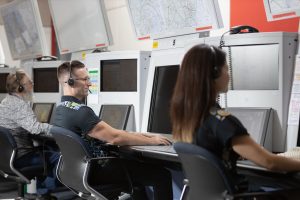
Inside Brisbane Centre.

Air traffic control is used to manage the safe and orderly flow of aircraft into, out of, and across Australian airspace.

We use systems and processes to minimise the risk of collisions, while allowing the maximum number of aircraft to fly safely in our skies.

Our air traffic controllers manage aircraft through all phases of flight, from terminal gate to terminal gate. The level of service provided by controllers varies depending on the class of airspace.

There are three broad categories of controllers: en route, terminal and tower. You can find out more about what they do under our careers section.

How airspace is managed

In Australia, there are two major types of airspace: controlled, and uncontrolled. Controlled airspace is monitored and most traffic is directed, to varying extents, by air traffic controllers.

Advances in air traffic control technology such as Automatic Dependent Surveillance Broadcast, is seeing traditional air routes being replaced by flextracks and user-preferred routes in the less busy controlled airspaces.

Much of the Australian airspace below 18,000 feet (5472 m) outside the eastern seaboard is classified as uncontrolled airspace. It is in this airspace where most recreational aircraft generally operate.

In uncontrolled airspace, pilots are often not visible to air traffic control but must still follow visual flight rules or instrument flight rules. In uncontrolled airspace controllers do not provide separation but provide a Flight Information Service and Traffic Information Service to aircraft flying on instrument flight rules and on request to aircraft flying on visual flight rules.

As well as being broken into controlled or uncontrolled airspace, Australian airspace is further divided into different classes, where internationally agreed rules for visual flight and instrument flying apply.

Australian airspace

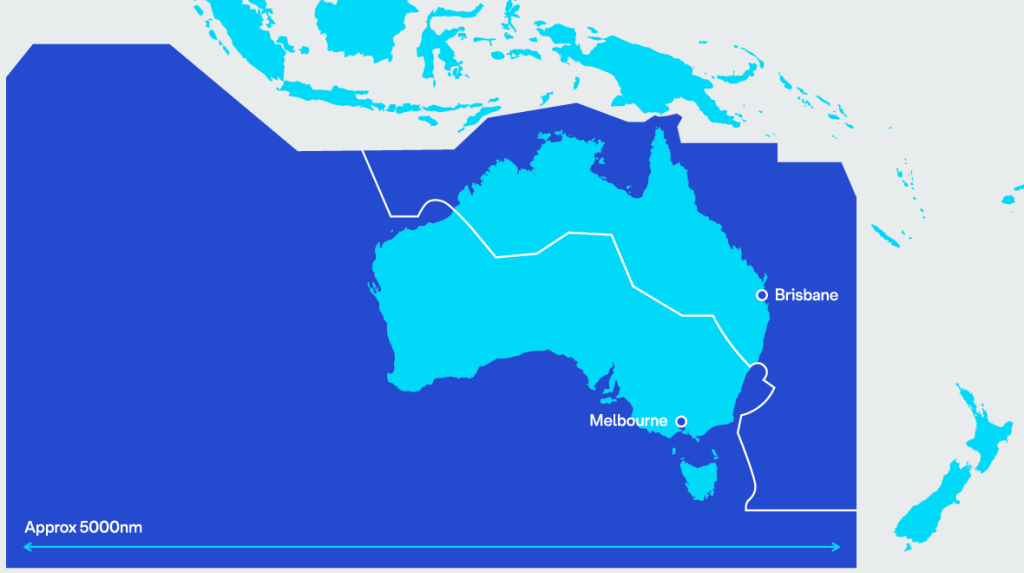
Our area of operations covers the Australian Flight Information Region which includes the nation’s sovereign airspace and international airspace over the surrounding oceans including the FIR’s of the Solomon Islands and Nauru.

We are responsible for the airspace stretching in latitude from two degrees to 90 degrees south; and in longitude from 75 degrees to 163 degrees east.

This is an area of almost 20 million sq nautical miles (51.7 million sq kms) – or some 11 percent of the world’s total airspace.

A graphical representation of Australia's airspace.

We provide our services in accordance with Civil Aviation Safety Authority regulations. Its airspace role is carried out in accordance with the International Civil Aviation Organization airspace classification system.

Australian airspace classifications

Class A: Instrument flight rules (IFR) flights only are permitted. All flights are provided with an air traffic control service and are positively separated from each other.

Class C: All aircraft must get an airways clearance and communicate with air traffic control. IFR aircraft are positively separated from both IFR and VFR aircraft. Visual Flight Rules (VFR) aircraft are provided traffic information on other VFR aircraft.

Class D: All aircraft must get an airways clearance and communicate with air traffic control. IFR aircraft are positively separated from other IFR aircraft and are provided with traffic information on all VFR aircraft. VFR aircraft are provided traffic information on all other aircraft.

Class E: IFR aircraft require an airways clearance and must communicate with air traffic control. IFR aircraft are positively separated from other IFR aircraft and given traffic information on known VFR aircraft. VFR aircraft do not require an airways clearance and are not required to communicate with air traffic control.

Class G: IFR and VFR flights are permitted and do not require an airways clearance. IFR flights must communicate with air traffic control and receive traffic information on other IFR flights and a flight information service. VFR flights receive a flight information service if requested.

More information